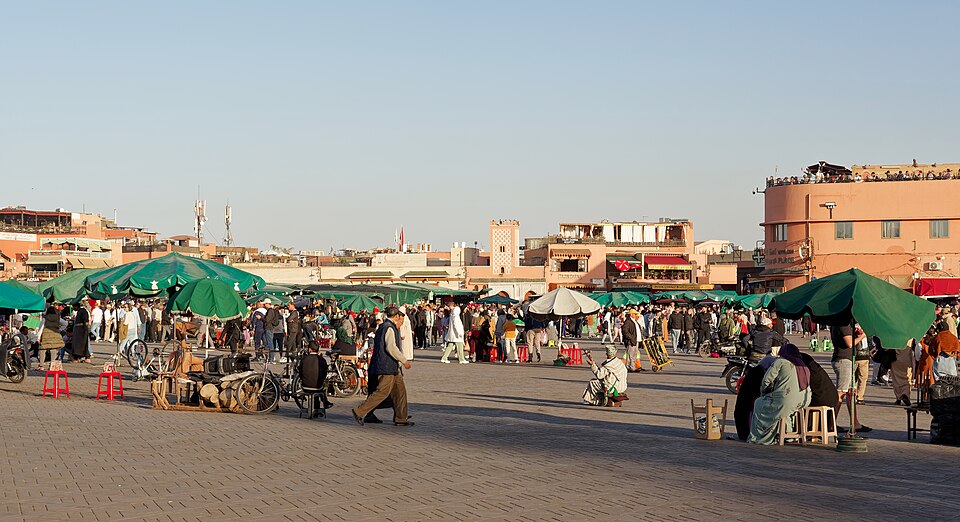

You cannot visit Marrakech without passing through Jemaa el-Fna. The great square at the edge of the medina is not a monument: it is a live show that changes completely between morning and night. Here is what you will see, when to go, where to sit for the view and how to avoid the small scams. For the rest of the city, see our guide to things to do in Marrakech.
The square hour by hour
| Time | Atmosphere | What to do |
|---|---|---|
| Morning | Quiet, almost empty | Fresh orange juice, photos without the crowds, head into the souks |
| Afternoon | The square fills up | Snake charmers, henna artists, water sellers |
| Late afternoon | Building up | Food stalls being set up, sunset from a rooftop terrace |
| Evening | Dense crowds, grill smoke, music | Dinner at the stalls, circles of storytellers and Gnaoua musicians |
| Late at night | Stalls gradually close | A last mint tea, then back along the main lit streets |
Times are indicative: the atmosphere varies with the season, the day of the week and during Ramadan.
What you will see
UNESCO proclaimed the "Cultural space of Jemaa el-Fna Square" a Masterpiece of the Oral and Intangible Heritage of Humanity in 2001, then inscribed it on its Representative List in 2008. What is protected is not a building but what happens on the square: a unique concentration of popular Moroccan traditions.
- Storytellers (halqa): circles of onlookers gather around a storyteller, poet or preacher. Even without understanding Arabic or Amazigh, you can feel the energy of the performance.
- Musicians: Gnaoua with their metal castanets, Amazigh musicians, players of the sintir (also called hajhouj).
- Traditional trades: fortune-tellers, herbalists selling traditional remedies, henna artists, water sellers in red costumes.
- Snake charmers and animal handlers, mostly during the day (see the precautions below).
Where does the name come from? Nobody knows for sure. "Jemaa" means mosque or assembly; "fna" can mean annihilation or an open space in front of a building. Explanations include a mosque on the square that was never finished, or the public executions said to have taken place there long ago, hence the often-quoted translation "assembly of the dead".
Eating on the square at night
In the late afternoon, dozens of numbered food stalls are set up in the middle of the square, with benches and shared tables. You will find grilled meat (kebabs, merguez), fried fish, snails in a spiced broth, tangia (meat slow-cooked in a clay jar) and, for the curious, rass, a sheep's head. The fresh orange juice stalls are open all day.
- Ask the price before you sit down and have it confirmed for each dish.
- Refuse what you did not order: bread, olives or sauces put on the table may end up on the bill.
- Pick a stall busy with Moroccans where food is cooked in front of you.
- Ignore the pushiest touts: their job is to get you seated, not to advise you.
If you would rather be accompanied the first time, a guided food tour lets you taste several specialities without worrying about prices.
Rooftop terraces with a view
To see the square from above, several cafés and restaurants around it have rooftop terraces, including Café de France and Le Grand Balcon du Café Glacier. Access is usually in exchange for buying a drink, at higher prices than in a neighbourhood café. Go up half an hour before sunset to get a spot at the railing: that is when the grill smoke rises and the square lights up.
Scams to avoid
- The monkey or snake on your shoulder: it is placed on you for a photo, then money is demanded. Say no before it happens. Barbary macaques are a protected species: better not to encourage this trade.
- The "free" henna: a woman takes your hand and starts a design, then asks for a large sum. Pull your hand back and say no firmly.
- The unagreed photo: photographing a musician or snake charmer up close will often lead to a request for money. Ask first, or drop a coin.
- The fake guide: someone offers to show you the way to the souks or your riad, then demands payment.
- Pickpockets: the evening crowd is their playground. Keep your phone and wallet in a front pocket or a closed bag.
For everything about going out after dark, read our guide is Marrakech safe at night?
Around the square
- The souks start just to the north, along the covered Semmarine street: see our guide to the Marrakech souks.
- The Koutoubia and its gardens are a few minutes' walk to the west: its minaret is a handy landmark to find your way back to the square.
- Staying nearby: a riad in the medina lets you walk back. For taxis, fares and meters, see our guide to taxis in Morocco.
Frequently asked questions
What is the best time to visit Jemaa el-Fna?
For the atmosphere, late afternoon and early evening, when the food stalls are set up and storytellers and musicians take their places. In the morning the square is quiet and ideal for photos.
Do you have to pay to enter the square?
No, it is a public space, open day and night. You only pay for what you eat or drink, plus the coins you give performers if you watch a show or take a photo.
Is it safe to eat at the night food stalls?
Many visitors eat there without any trouble. Choose a busy stall where food is cooked in front of you and served hot, and always ask the price before you sit down.
Is Jemaa el-Fna a UNESCO site?
Yes: its cultural space was proclaimed a Masterpiece of the Oral and Intangible Heritage of Humanity in 2001, then inscribed in 2008 on the Representative List of the Intangible Cultural Heritage. The surrounding medina has been a World Heritage Site since 1985.
This article is indicative: the atmosphere, times and prices on the square vary with the season. Always ask the price before eating, drinking or taking a photo.