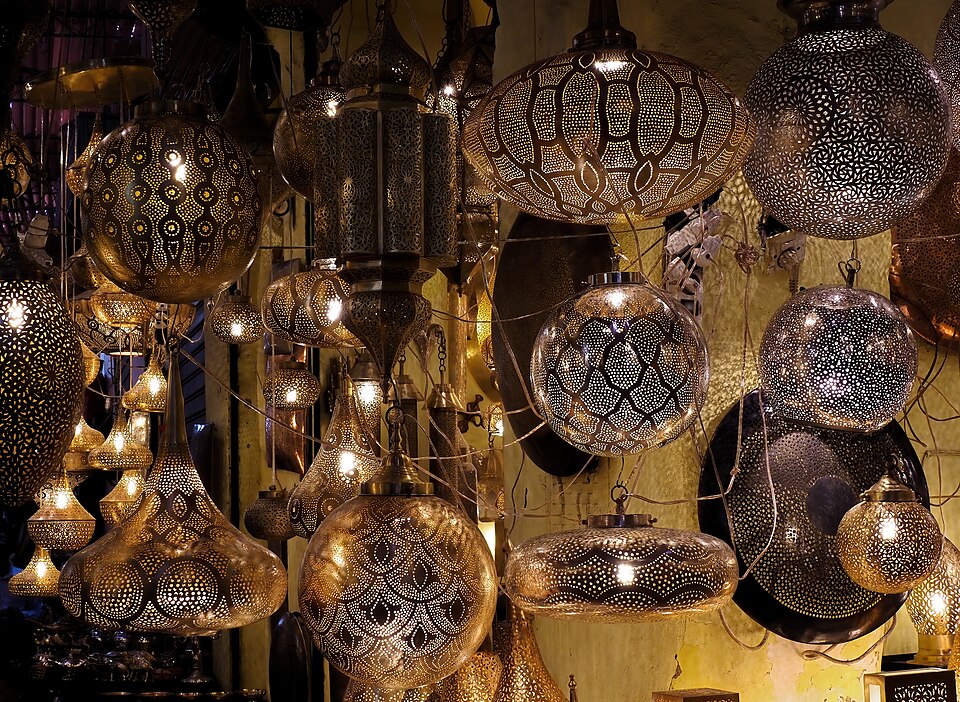

The Marrakech souks are a maze of market lanes just north of Jemaa el-Fna square. For centuries each quarter was dedicated to one craft: dyers, blacksmiths, leatherworkers, carpenters. This guide helps you find your way, choose what to buy and haggle without stress. For the rest of the city, see our guide to things to do in Marrakech.
The souks at a glance
| Souk or place | Speciality | Good to know |
|---|---|---|
| Souk Semmarine | Textiles, pottery, souvenirs | Broad covered street starting north of Jemaa el-Fna: the main artery |
| Rahba Kedima | Spices, herbalists, baskets, hats | Small square with traditional cosmetics and herbal remedies |
| Souk Zrabi (carpet souk) | Carpets | Reached through a passage off Rahba Kedima |
| Souk Attarine | Once spices and perfume, now mostly copper and brass | A branch of Semmarine |
| Souk Haddadine | Ironwork, pierced metal lanterns | The blacksmiths' quarter, noisy and photogenic |
| Dyers' souk (Sebbaghine) | Dyed wool and silk | Colourful skeins hanging above the lanes |
| Souk Cherratine | Leather goods | Bags, belts, wallets |
| Souk Smata | Babouches | The traditional slipper souk |
| Souk Chouari | Woodwork | Wooden items, often cedar |
Names are spelled in several ways (Semmarine or Smarine, Rahba Kedima or Lakdima) and specialities increasingly overlap: this table is a guide only.
Finding your way
The easiest way in is from the north side of Jemaa el-Fna, along the covered street of Semmarine. It splits into several branches leading to the specialist souks. The further north you go, towards the Ben Youssef Madrasa, the narrower and more workshop-like the lanes become.
- Keep two landmarks: Jemaa el-Fna to the south and the Ben Youssef Madrasa to the north. Signs pointing to "Place Jemaa el-Fna" help you get out.
- Download an offline map before you go: mobile signal is weak under the roofs.
- Getting lost is part of the fun: if you need directions, ask a shopkeeper inside their shop rather than someone who approaches you in the street.
- Watch out for scooters: they use the lanes too, so keep to the side.
The main souks, craft by craft
Souk Semmarine, the main artery
A broad street covered by a wooden lattice that filters the light, Semmarine is the gateway to the souks. It sells textiles, kaftans, pottery and plenty of souvenirs. It is also the busiest street, so prices are often higher than in the side lanes.
Rahba Kedima, the spice square
This small open-air square gathers herbalists and sellers of spices, traditional cosmetics (black soap, kohl, argan oil), woven baskets and hats. Several terraces overlook it, a good break to watch the bustle. A passage leads to the carpet souk.
Haddadine, Attarine and metalwork
In Souk Haddadine, blacksmiths work iron and metal in front of you: this is where the famous pierced lanterns come from. Souk Attarine, once the spice and perfume market, is now known for its copper and brass.
The dyers, leather and babouches
In the dyers' souk, freshly dyed skeins of wool and silk dry above the lanes, one of the most photogenic corners of the medina. Souk Cherratine belongs to the leatherworkers and Souk Smata to the babouche makers.
What to buy
- Babouches, embroidered or plain leather: the classic souvenir.
- Lanterns and lamps in pierced metal or copper.
- Berber rugs: a big purchase, so take your time and compare several shops.
- Spices (ras el hanout, cumin, saffron), black soap and argan oil: ideally from a shop that also sells to locals.
- Leather goods: bags, belts, leather poufs.
- Pottery and ceramics: decorative tagines, bowls, painted dishes.
Before buying, visit the Ensemble Artisanal on Avenue Mohammed V, near the Koutoubia: items there are sold at marked prices with no haggling. Those prices are a useful benchmark for what things are worth in the souks.
Haggling without stress
In the souks, most prices are not displayed and haggling is the norm. The first price quoted to a tourist is often well above the real value. A few simple rules:
- Set yourself a maximum price before asking, using the Ensemble Artisanal prices as a guide.
- Offer well below the first price, then go up slowly: advice varies, but many suggest starting at around a third to a half.
- Stay friendly and patient: accepting a glass of tea does not commit you to anything.
- Don't name a price unless you are ready to buy: backing out once a deal is agreed is frowned upon.
- Walking away politely is your best argument: the seller often calls you back with a better offer.
- Carry cash in dirhams and small change: many small shops do not take cards.
For everyday prices (tea, coffee, taxis), see our page on prices in Morocco.
Opening hours, fake guides and practical tips
- Hours: most shops open mid-morning and close in the early evening, every day. On Fridays, the day of the main weekly prayer, some shops close from late morning to early afternoon.
- Fake guides: politely decline people who offer to guide you, claim a monument is closed or say a "Berber festival" is on today: it is often a way to lead you to a shop where they earn a commission. Official guides carry a badge.
- Guided tour: for a first visit, an official guide booked in advance stops you getting lost and explains the craftspeople's work.
- In the evening: the souks empty when the shops close; stick to the main lit streets. See our guide Is Marrakech safe at night?
- Photos: ask before photographing a craftsperson or shopkeeper.
Frequently asked questions
Where are the souks in Marrakech?
In the medina, just north of Jemaa el-Fna square. The easiest way in is the covered street of Semmarine, which leads to the specialist souks as far as the Ben Youssef Madrasa area.
Should you haggle in the souks?
Yes, in most shops without marked prices. Set a maximum price, offer well below the first price and stay polite. To avoid haggling, the Ensemble Artisanal sells at marked prices.
How much time do you need for the souks?
Allow 2 to 3 hours for a first visit, more if you plan to buy a rug or compare several shops.
Are the souks open on Fridays?
Yes, but some shops close from late morning to early afternoon for the main weekly prayer. Mornings or late afternoons are a safer bet.
Can you pay by card in the souks?
Some larger shops take cards, but most small traders prefer cash. Bring dirhams in small notes.
This article is a guide only: opening hours and souk specialities change. Check details on site or with your guide.